The Wait is over, verdict is out and there is no ambiguity or confusion in the message. People of India have chosen their winner without any “ifs and buts” and the winner is- Narendra Modi, a leader who single handedly decimated all the opposition parties, destroyed all the barriers created on his path and deflected all the allegations and cuss words thrown at him by desperate opposition.
When different exit polls indicated that BJP led NDA might come back to power with majority, there were not many takers from opposition. Expecting a complete reversal in actual result, major opposition leaders even started their hectic parleys to ensure they had numbers on their side to form a Government, when election results were declared, and Hung parliament was announced-where no party or alliance would have had absolute majority.
The result did prove most of the exit polls wrong, albeit in completely opposite way. BJP led NDA swept the poll with 352 seats out of 542 seats, while BJP alone claiming 303 seats, way above 272 mark, required for absolute majority. BJP led NDA also managed to get 46% vote share, up by 6% from 2014. This unique feat, made Mr.Modi, first non-congress Prime Minister of India, to be re-elected after completing first term of five years. It also made him first Prime Minister in three decades to be re-elected with absolute majority on its own, an accomplishment last achieved by Mrs. Indira Gandhi in 1984. So much was the dominance of this unstoppable juggernaut of Mr.Modi and Mr.Shah, that Congress, second biggest party in the Election won only 52 seats, compared to 303 seats of BJP.
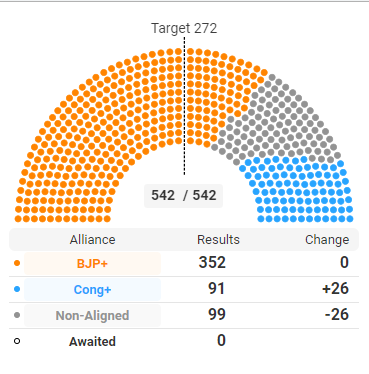
Source: https://www.ndtv.com/elections
The achievement is even more significant due to growing influence of coalition governments in India during 90’s and early 21st century. Many pundits thus assumed that it would be difficult for any single party to get more than 200 seats or 30% vote share, let alone getting absolute majority. The primary reason for such conception was emergence of regional parties and their growing vote banks. SP, BSP and Trinamool congress are some of the examples of such regional parties, commanding sizable vote share in their respective states. However, Under Mr. Modi and Mr. Shah, BJP managed to break the shackle and brought back dominance of National parties in India’s political arena. As I have mentioned in my earlier post, this was an election, which was fought in the name of Mr. Modi- and was seen by political observers as a referendum on Mr. Modi’s popularity and “Nationalistic Policies”, a litmus test that Mr. Modi passed with full marks.
In 2014, when BJP alone won 282 seats, political experts said that the party reached its peak and for BJP, there would only be downward movements in terms of seat tally during future elections. They argued that BJP and NDA won most of the seats in Hindi heartland and Karnataka, where it had presence, including complete sweep in Delhi, Rajasthan, Gujrat and steller performance in Uttar Pradesh (73 out of 80) , Madhya Pradesh (27 out of 29), Chhattisgarh (10 out of 11) and Bihar (28 out of 40) . Thus many thought that there were little chance for BJP and NDA to improve its tally in 2019, considering they were also facing the anti-incumbency factor.
However, Mr.Modi and Mr.Shah had different plans and visions. They also, seemingly admitted, that repeating 2014’s performance in Hindi Heartland was difficult. So, BJP needed the numbers to compensate for possible loss from its strongholds. The duo deployed time tested and brilliant strategy- venturing into unchartered territory. BJP, having strong foothold in North and Western part of India, barely had any presence in Eastern part of India, barring Bihar. So Mr. Shah and Mr. Modi underscored the importance of making inroads in Eastern States, including West Bengal, third largest state in terms of number of Parliamentary seats. This required long planning and preparation, which started way back in 2015 and yielded miracle for BJP. They won Tripura Assembly election, where they had no presence even three years back, expanded its presence in all parts of North East India, and steadily increased its organization and vote share during all local elections in West Bengal and Odisha. To Mr. Shah and Mr. Modi, the win in local elections of West Bengal and Odisha, were seen as mock ups for the Final battle- General Election 2019.
On the other hand, retaining as many seats as possible in their strongholds was another key task for the duo. That was not easy either. They knew that there would be anti-incumbency factors, consolidations and alliances among opposition parties, which could cause severe dent in BJP’s seat tally. So, they needed to up their game and be one step ahead of their opposition to retain their dominance in those strongholds.
In my last post, I mentioned that two states held the key of 2019 election results- Uttar Pradesh and West Bengal. In both the states, Narendra Modi led BJP did exceptionally well, considering the formidable opponent they faced. In UP, BJP was up against alliance of Samajwadi Party (SP) and Bahujan Samajwadi Party (BSP). SP and BSP together had a loyal vote-bank of Yadavs, Dalits and large number of Muslims, comprising more than 40% of total votes in Uttar Pradesh. In Bengal, BJP was facing incumbent Trinamool Congress, who won 34 seats out of 42 in 2014 parliamentary elections, with more than 40% vote share. And what was at stake in these two states – 122 number of seats, out of which BJP won 75 in last election- 73 in UP and only 2 in West Bengal. So Mr. Modi and his general- Mr. Amit Shah knew that it was of paramount importance to retain as many seats as possible in UP, while making inroads in Bengal and gain as many new seats as possible. The task was uphill, but nothing seemed to be impossible to Modi and his “Chanakya” Amit Shah.
In Uttar Pradesh, facing formidable Mahagatbandhan, which had numbers on its side, BJP did not budge under opposition’s pressures. BJP realized that caste-based equation was not in its favor and if they wanted to win, then had to find a solution to douse the issue in UP. It was easier said than done as caste-based politics was deep rooted in the history of India. So, BJP started to engineer reverse caste politics, bringing people from all other castes and strata under its umbrella to increase the vote share. It also tried to break caste barrier and persuade the voters, irrespective of caste and religion, to vote in favor of BJP’s nationalistic and pro-poor policies. It also mobilized ground level teams at every booth to help it increase voter connects. All these strategy and efforts seemed to have worked for BJP as they won as many as 64 seats, only 9 fewer than their tally of 73 in 2014. On the other hand, Mahagatbandhan only managed to win 15 seats, a result which was unexpected to most poll-experts.
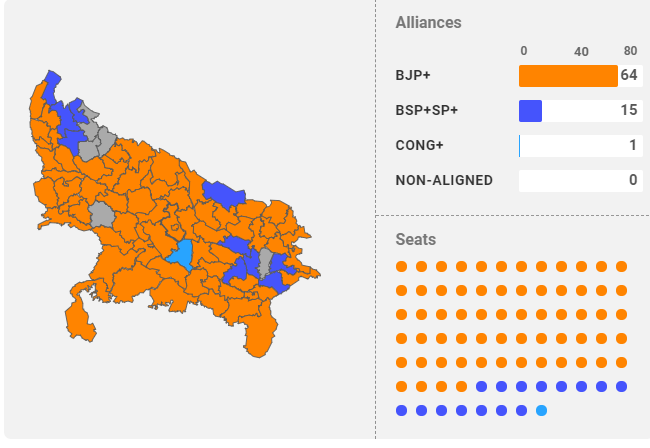
Source: https://www.ndtv.com/elections
In West Bengal, battle was even more intense. While facing Mamata Banerjee, a seasoned politician and fierce competitor, at her own citadel-West Bengal, BJP also faced the challenges of weak local leadership and organization. In West Bengal, BJP lacked strong leadership and organizational strength to take on Mamata Banerjee led Trinamool congress (TMC). Also, BJP’s image as Pro-Hindu party had a negative impact on the minority vote base, which constitutes more than 27% of total voter population of West Bengal. So the task was difficult. Famous duo of Modi and Shah decided to take the heat on opposition by campaigning extensively in West Bengal during the election months. Special attention from Mr.Modi and Mr.Shah rejuvenated the morale of west Bengal BJP supporters. Also, many key leaders from TMC, who were disgruntled with current regime of Mamata Banerjee, switched side and joined BJP, giving BJP necessary leader-base that it was lacking earlier. With fading popularity of left and Congress in Bengal, BJP filled the vacuum and established itself as credible alternative to Trinamool Congress. All these efforts resulted into 23% vote share increase by BJP in Bengal. All these factors played a crucial role for BJP to increase its vote share from 17% to 40 % and win 18 out of 42 parliamentary seats in West Bengal, up by 16 seats, as compared to 2014.
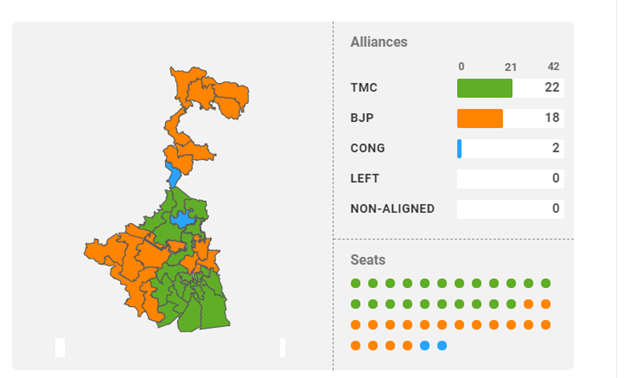
Source: https://www.ndtv.com/elections
So, we can see strategy planning and preparation played a crucial role for BJP’s success in these key states. Also people of India had disposed their faith towards Mr.Modi and Mr.Shah and their narratives. But why opposition could not convince people? Why there was no takers for oppositions’ points and arguments?
Was there any other life lesson that we can draw from this election? Yes, there are …
We will discuss them in upcoming posts. Stay tuned.
Author’s Note: All Views expressed on this site are my own and do not represent the opinions of any entity whosoever with which I have been, am now or will be affiliated.
Image source for Mr.Narendra Modi- freepngimg.com
 Maa Tujhe Salaam