As Indian Parliamentary Election came to an end, all eyes are now on the D-Day , 23rd May, 2019, when result for world’s largest democracy will be declared. Fate of 542 parliamentary seats will be decided along with assembly election results for the states of Odisha, Andhra Pradesh, Arunachal Pradesh and Sikkim. More than 600 million voters exercised their voting rights, out of total of around 900 million voters, making it the biggest election ever in the history of India and world. 2019 elections witnessed highest ever voter turnout with more than 67% voters casting their votes.
Now that the election is over, biggest question is who is going to be the winner. Will it be BJP led. National Democratic Alliance (NDA) or Congress led United Progressive Alliance (UPA)? Or will it be, as many pandits predicted, a non-Congress, non-BJP third front, which might end up being into the power, backed by Congress, as we have seen in the case of Karnataka?
Once the polling was over on 19th may at 6.00 p.m., almost all major media houses started broadcasting their exit polls. To many people’s surprise, almost all exit polls predicted clear victory and majority for NDA, while some exit polls predicted that NDA may fall short of magic figure of 272 by 10-30 seats. Let us look at most of the major exit polls prediction, showing tentative seats NDA, UPA and others are going to win-
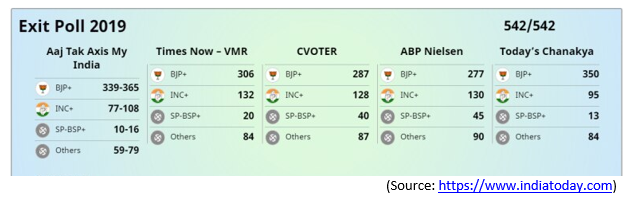
While BJP+ represents the tentative seats for NDA, INC+ represents UPA while SP-BSP+ and others together represent so called third front or federal front. Looking at the numbers, one can easily say that NDA is on its way to return to the power. But hold on, the same was said during 2004 also, when most of the exit polls predicted return of NDA at center, while it was UPA, which had the final lough during the counting day. Even in recently held Australian election, most of the psephologists predicted win for the liberals while in actual, it was conservatives who stormed back to the power. Also, there are other examples of exit polls getting it all wrong, including victory of Donald Trump in US presidential election in 2016. But does this mean that all these exit polls are wrong and something totally contrasting result going to emerge on 23rd. May be, may not be. Because historically, in India, exit polls were right, at least trend wise, in more occasions than they were wrong. In 2009, in 2014, exit polls predicted the trend quite correctly, although the margin of victory was way off the line.
2019 election was probably most bitterly fought election in the history of Indian politics. We have witnessed polarization among the party supporters like we witnessed never before. And standing at the center of the fight, it was Prime Minister Narendra Modi, who was truly the central figure of this election. While NDA, especially BJP is confident that they can retain power under strong and charismatic leadership of Narendra Modi, opposition parties condemned him as authoritarian and tyrant. Because of such contradictory narratives about Mr. Modi, he became the central point of discussions during the election. So any victory for BJP can be attributed as victory of Narendra Modi, while his detractors will be univocally call the poll result as mandate against Mr.Modi, in case BJP fails to cross 200 marks, a figure, that many believe, is the key to form a government.
Who will win? We will get to know in a day’s time. Meanwhile, there are two states, which can shape the outcome of this crucial General election-2019
- Uttar Pradesh: As it emerged from various exit polls, most difficult state to predict is Uttar Pradesh (UP), the state, with highest number of seats – 80. UP was one of the main reasons behind the astonishing success of BJP led NDA in 2014, during which NDA won 73 out of 80 seats in UP. However, this time around, BJP is going to face a formidable opponent in the form of “Mahagatbandhan”, which was formed by the alliance between former arch rivals Akhilesh Yadav led Samajwadi Party (SP) and Mayawati led Bahujan Samajwadi Party (BSP). It is a well-known fact that Yadavs and Muslims, constituting sizable proportion of total population in UP, are with SP, while BSP has allegiance from Dalit voters, who are more than 20% of total population of UP. Even in 2014, BSP and SP, who then fought separately, garnered more votes together than BJP did. So Mahagatbandhan is expecting to maintain similar vote share based on its influence on its loyal vote bank- Yadav, Muslims and Dalits. SP and BSP alliance is also expecting to gain from the anti-incumbency factors as both the state and center is ruled by BJP.
On the other hand, BJP tried its best to bring all other casts under its umbrella to increase its vote share. BJP campaigned extensively among traditional Yadav and Dalit bastons, trying to reduce impact of caste-based politics and loyalties. It is also heavily banking on the charisma of Mr.Modi to break the caste barrier and consolidate Hindu votes. BJP, which is known for its inclination towards right wing Hinduism, also expecting some significant vote share from Muslim women as it promised to abolish “Triple Talaq” -a move supported by many women activists.
The result in UP can have a long-lasting impact on Indian Politics. SP-BSP win can reaffirm importance of regional players and caste-based politics in Indian Political arena. On the other hand, if BJP manages to emerge as victorious, new trends of reverse consolidation and strong leader centric politics can set the tone for future elections.
- West Bengal: If there is any state, whose exit poll predictions created a shock wave among political pundits, it was West Bengal. Almost all exit polls indicated a significant increase in seats and vote share for BJP, predicting 11-18 seats for BJP out of 42 seats, with a vote share of 30-40%.
In West Bengal, known as the baston of Trinamool Congress (TMC) and its supreme commander – Ms. Mamata Banerjee, TMC bagged 34 seats out of 42 with a whopping 41% vote share in 2014. Ms. Banerjee enjoys support from large part of Muslim community, which constitutes more than 27% of total populations in the state. Ms. Banerjee, popularly known as “Didi” (meaning Sister in Bengali) also is probably the most popular leader in Bengal. Backed by all these facts, hardly anyone thought that Didi can face any stiff challenge from her oppositions in Bengal.
However, BJP national president Mr.Amit Shah seemed to have different thoughts. Knowing very well that his party reached a saturation in West and North India, he looked for expansion of BJP’s footprints in states where it had minimal presence. He gave key importance to increase its tally in West Bengal, where BJP managed to get only 2 seats in 2014 with only 17% vote share. Cashing in on the anti-incumbency factor in the state and alleged minority appeasement policies by TMC, BJP made significant inroad in West Bengal in last five years. Though TMC managed to hold its vote-bank intact, apparently BJP’s vote share rose significantly in last two years at the cost of Left parties and Congress. And if exit polls are to be believed, BJP is quite successful in achieving its target to increase its tally and vote shares significantly in west Bengal, which can be crucial for its return to power at national level. On the other hand, such result can make a serious dent in the national level aspiration of Mamata Banerjee, who is hopping to lead the country, backed by several regional parties, in case both NDA and UPA fail to get majority mandate.
Performance of Political parties in these key states can decide their fate for next five years. These two states can set the tone for electoral outcome on 23rd May.
Which way people voted, we will get to know soon. Till then, stay tuned…
 Maa Tujhe Salaam